
Climate of Pakistan: Seasons, Monsoon and Western Depressions (O Level Geography)
Climate is the foundation of Pakistan Studies Paper 2. It explains why crops grow where they do, why water supply changes through the year, and why Pakistan faces floods, droughts and heatwaves.
Factors Affecting Pakistan’s Climate
- Latitude: Pakistan lies in the sub-tropical zone, so summers are very hot in the plains.
- Altitude: temperatures fall with height, so the northern mountains are much cooler.
- Distance from the sea: the Arabian Sea keeps coastal areas like Karachi milder, while inland areas have more extreme temperatures.
- Relief: mountains force moist winds to rise and give more rainfall on windward slopes.
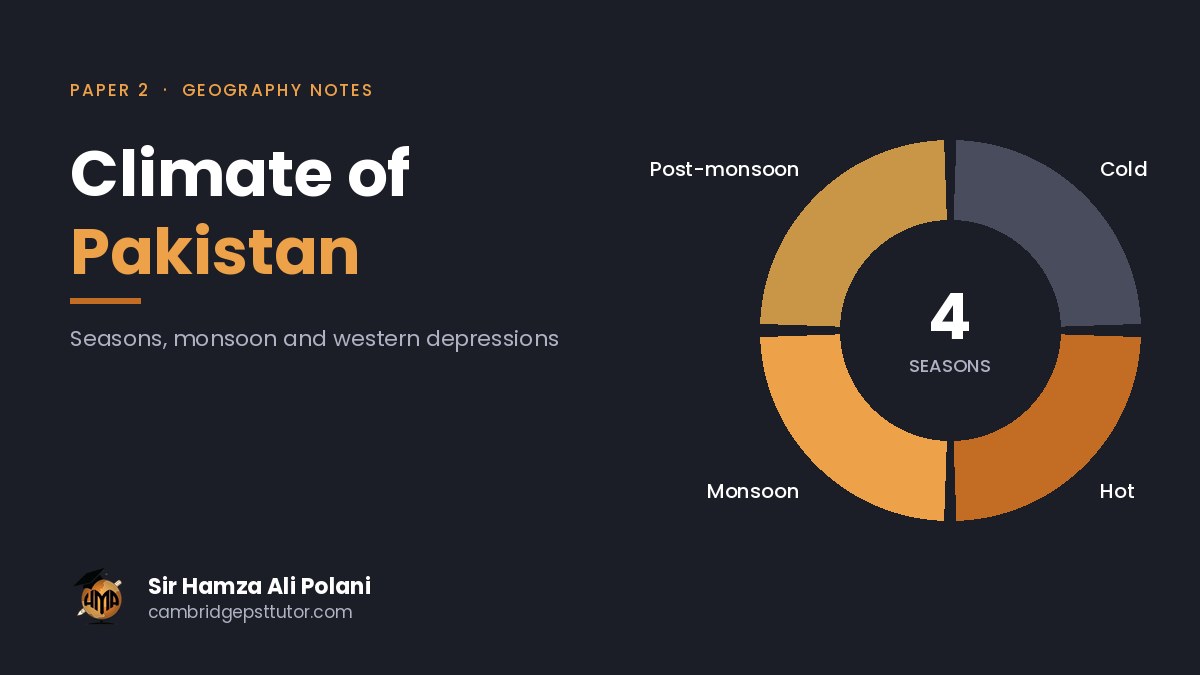
The Four Seasons
- Cold season (about November–February): cool to cold, with snow in the north.
- Hot season (about March–May): very high temperatures in the plains; places such as Jacobabad and Sibi are among the hottest in the region.
- Monsoon season (about June–September): most of Pakistan’s rainfall arrives.
- Post-monsoon (about October–November): dry and pleasant.
The Monsoon
In summer, the land heats up and forms low pressure, drawing moist winds from the Indian Ocean and Bay of Bengal. These monsoon winds bring heavy rain, mostly to north-eastern Pakistan and the foothills. Rainfall decreases towards the south-west, which is why much of Sindh and Balochistan is dry.
Western Depressions
In winter, low-pressure systems from the Mediterranean region travel east and bring rain and snow to northern and western Pakistan. This winter rain is very important for Rabi crops such as wheat — see our notes on agriculture in Pakistan.
Climate Regions
- Highland climate: northern mountains — cold winters, mild summers, snowfall.
- Lowland / plains climate: Indus plain — very hot summers, cool winters, moderate monsoon rain.
- Coastal climate: Karachi and the Makran coast — mild temperatures, humid, low rainfall.
- Arid climate: Balochistan and desert areas — very low rainfall and large temperature ranges.
Climate Hazards
- Floods: heavy monsoon rains and glacier melt, as seen in major floods such as 2010 and 2022.
- Droughts: especially in Sindh and Balochistan when rains fail.
- Heatwaves: extreme summer temperatures in cities and the plains.
- Glacier melt: rising temperatures affect water supply and increase flood risk.
Exam Tip
When asked to explain rainfall patterns, mention the source of the winds, the season, and the effect of relief. Use named places to support every point.
Frequently Asked Questions
What are western depressions?
Winter low-pressure systems from the Mediterranean region that bring rain and snow to northern and western Pakistan.
Why does Karachi have a mild climate?
Its location on the coast means sea breezes keep temperatures moderate throughout the year.
Study Pakistan Studies with Sir Hamza Ali Polani (HMA)
Sir Hamza Ali Polani has 12+ years of teaching experience in Cambridge O Level and IGCSE Pakistan Studies and Geography, and is Director of Verge Schooling System & Coaching Centre, Karachi. His students have achieved 6000+ A* and A grades and 3500+ B grades. Classes are available online and on-campus in Karachi.
Studying O Level Pak Studies? See the complete O Level Pakistan Studies classes: Paper 1 History, Paper 2 Geography, exam technique and free class.
Online classes across Pakistan: Karachi · Lahore · Islamabad & Rawalpindi · Multan · Faisalabad · Peshawar · Sialkot · Hyderabad
Book a free class · WhatsApp +92 331 2364114 · See student results