
Sir Syed Ahmad Khan and the Aligarh Movement: O Level Pakistan Studies Notes
Sir Syed Ahmad Khan (1817–1898) is one of the most important figures in Pakistan Studies Paper 1. His work — known as the Aligarh Movement — changed the direction of Muslims in the subcontinent after 1857. Questions on him appear regularly, so learn this topic thoroughly.
Why Sir Syed Started His Work
After the War of Independence 1857, the British largely blamed the Muslims. Muslims lost jobs, land and influence, and many refused Western education. Sir Syed believed Muslims would fall further behind unless they rebuilt trust with the British and accepted modern education.
1. Improving Relations With the British
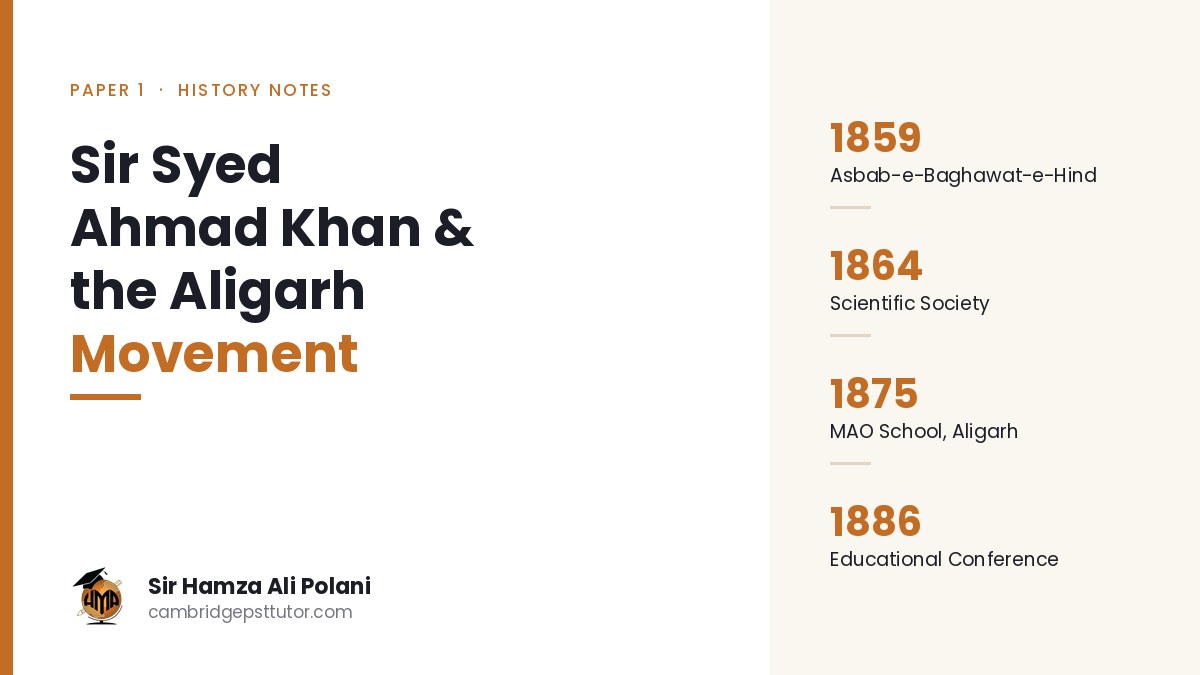
- He wrote Asbab-e-Baghawat-e-Hind (The Causes of the Indian Revolt), explaining that British policies — not only Muslims — were responsible for the uprising.
- He published the Loyal Muhammadans of India, showing examples of Muslims who had stayed loyal to the British.
- He wrote a commentary on the Bible to show the common ground between Islam and Christianity.
2. Educational Reforms
- Scientific Society (1864): translated Western works on science and other subjects into Urdu.
- Tahzib-ul-Akhlaq: a journal that encouraged Muslims to modernise their thinking and way of life.
- MAO School, Aligarh (1875): the Muhammadan Anglo-Oriental School, which became a college in 1877. It offered Western education alongside Islamic teaching, and later became Aligarh Muslim University.
- Muhammadan Educational Conference (1886): promoted modern education for Muslims across the subcontinent.
3. Political Guidance
- After the Urdu–Hindi controversy (from 1867), Sir Syed became convinced that Hindus and Muslims were two separate nations with different interests — an early form of the Two-Nation Theory.
- He advised Muslims not to join the Indian National Congress (founded 1885), believing it would mainly represent Hindu interests.
Why Was the Aligarh Movement Important?
- It created an educated Muslim class who later led the political struggle for Pakistan.
- It restored some trust between Muslims and the British.
- It gave Muslims a sense of separate identity that grew into the Pakistan Movement.
Exam Tips
- Always link Sir Syed’s work back to the situation after 1857 — this shows understanding, not just memory.
- For “how far” questions, compare his educational work with his political and religious work, then judge which had the greatest impact.
- Use exact names and dates: 1864, 1875, 1877, 1886.
Learn the structure for these answers in our guide: How to Answer “How Far Do You Agree” Questions.
Frequently Asked Questions
Is Sir Syed Ahmad Khan the founder of the Two-Nation Theory?
He is widely regarded as one of its earliest voices, as he described Hindus and Muslims as separate nations after the Urdu–Hindi controversy.
What was the MAO College?
The Muhammadan Anglo-Oriental College at Aligarh, founded by Sir Syed, which combined Western and Islamic education and later became Aligarh Muslim University.
Study Pakistan Studies with Sir Hamza Ali Polani (HMA)
Sir Hamza Ali Polani has 12+ years of teaching experience in Cambridge O Level and IGCSE Pakistan Studies and Geography, and is Director of Verge Schooling System & Coaching Centre, Karachi. His students have achieved 6000+ A* and A grades and 3500+ B grades. Classes are available online and on-campus in Karachi.
Online classes across Pakistan: Karachi · Lahore · Islamabad & Rawalpindi · Multan · Faisalabad · Peshawar · Sialkot · Hyderabad
Book a free class · WhatsApp +92 331 2364114 · See student results